Showing posts with label European Vacation; Heidi; Maddie; Reiner; Petra's House; Family; Berlin. Show all posts

Monday, April 27, 2015

Too Much Culture? No Such Thing!

Petra's House, April 27, 2015, 8:51 p.m.

Yesterday, after our tour through Charlottenburg Schloss, Onkel Werner noted that too much culture was not a good thing. Nature and looking to the future, not the past, are better, he argued.

I love Onkel Wernerl. But, damn, he was wrong.

Today started leisurely enough, sleeping late and having breakfast.  We finally left the house, Petra, Melli, and four Herbons.  Onto the u-bahn and downtown to Unter den Linden.  A short walk down this important road, the major east-west access across the city and the site of amazing historical events, reminded me of just how much work still goes on to heal the scars of those decades of separation. While the area around the Brandenburg Gate has all been fixed up, with the foreign embassies lining the road just like they did before WWII, we headed further east, where construction efforts still go on.

While our ultimate destination was the German Historical Museum, we were distracted first by the Neue Wache.  This neo-classical building was originally built in 1818 to replace the former guardhouse that served the Royal Palace....

O.K., I have to stop here to describe the scene in front of me.  Maddie has brought out a pack of cards, and she, Reiner, and Petra are playing a game of poker.  This is new for Petra, so Maddie and Reiner played a demonstration hand. After explaining everything and getting to the point of showing their hands, Reiner proudly lays down his hand, noting with his usual air of certainty that Maddie had been trying for a flush or straight and that she didn't get it and, thus, he was winning with his pair of twos.  Without any undue fanfair, Maddie laid down her cards.  "Two pairs."  Spontaneous applause broke out in honor of Maddie's cagey poker skills.

....Oh, yeah, Neue Wache.  Until the German monarchy met its fate after WWI, the guardhouse served its original purpose. In 1931, the building was redesigned to commemorate those who died in the Great War. Then, those damn Nazis came to power and started using the building for their annual memorial day festivities (those guys ruined things for everybody).  After heavy damage in WWII, the East Germans turned the building into a memorial to those who died at the hands of the facists, burying the remains of an unknown soldier and of a nameless victim of one of the concentration camps under the floor, and placing a Kathe Kollwitz sculpture on the top.  Very moving way to remind people of the suffering brought forth by war--it's all about peace (Yvette!!).


After this quick visit, we trooped along to the German Historical Museum.  Housed in the old armory, the exterior of the building is undergoing renovation.  But, walk through the big revolving door (which Petra did with some trepidation) and the museum inside is world class.  It took us probably two to three hours or so to just give the place a cursory look.  Arranged in chronological order, with "order" being the key word, the museum covered the Germanic peoples from Late Antiquity to reunification.  


After posing with Marx and Engels at
Babelsburg, now I pose with Lenin


Walked around the corner and recognized
Cardinal Richleiu from his portrayal by Charleton Heston 

Reiner and Melli each independently recognized the Sun King 

According to Heidi, this is Grandma and Papa
when they were first married

Took this pic for Sascha--this little doll has
a removeable top of the head for
the storing of tobacco

Hey!  It's Reiner and the display on the
American Revolution!

I appreciated the way the curators covered things so thoroughly, yet in a way that was accessible.  There was no attempt to pull at anyone's heart strings, like at the Jewish Museum or Sachsenhausen, but just a plain ol' everyday telling of history.  And I especially appreciated the way that the history after WWI was laid out, with the meltdown of the Weimar Republic, the battles between the various political parties, and the slow but sure rise of the Nazis. The museum didn't stint on Germany's less savory historical aspects, with an especially moving sculptural interpretation of Auschwitz, but neither did it go crazy with too much focus on any one event in order to be politically correct.


This dollhouse comes with a picture of Hitler
on the wall of the living room.... 

....and a picture of Hitler and Mussolini in
the kitchen


Heidi reading the newspaper

I absolutely plan on coming back to Berlin, of course, and I would love another opportunity to see the museum.  Worth the effort, the musem turned out to be so good that I (again!!) broke my iron-clad embargo and bought a book. I swear this stops now!!!

Tonight has been just for chillin', a word the same for German and English.  Melli, Oliver, and TJ joined Reiner, the girls, Petra, and I for dinner here at home. And, when it was time for TJ and Oliver to leave, it was again difficult to say goodbye.  TJ is absolutely adorable, and Oliver's sense of humor and his devotion to TJ and Melli made me fall in love with him, too. Lecker Germans!

Now we're watching continuing coverage of the earthquake in Nepal and the straight poker has turned to Texas Hold-Em.  I'm going to close this, pack in anticipation of tomorrow's departure, and crawl into the little bed by the window.  I'm going to miss this place--until I come back!!


Beginning and Ending with Liquor

Petra's House, April 27, 2015, 10:10 a.m.

I begin this blog where I left off on the last blog, the evening of April 25, cozy in the flat on Ordensmeisterstr.  Petra made a delicious goulosh for dinner, and we simply stayed in for the evening.  Gifts had been purchased for Mika, which caused quite a riot of excitement.


After Reiner and Mika went to bed, Petra, the girls, Sascha, and I stayed up to talk.  Talk turned to the subject of liquor and, before you knew it, the eierliquor was out.  

Eierliquor?  Yes, the literal translation is "eggs liquor."  I tried it the first time I came to Berlin, back in 1990.  On that fateful day, we had started drinking beer in the afternoon and continued through dinner and afterwards.  Petra got the brilliant idea to serve me her East German aunt's homemade eierliquor, with beer chasers. The word "drunk" does not do justice to my state that night (worse was the morning after, when I had to be introduced to Reiner's stern Aunt Dora looking like a girl who had stayed up all night drinking).

But back now to 2015.  This time it was Petra who made the eierliquor from scratch.  Sascha served as barman, delivering the bottle and glasses to the girls, Petra, and me in the living room.  And OMG was it good!  I remember it as having tasted terrible that first time, but this time it was like drinking cake batter with an alcoholic kick.  Between the four of us, we polished off Petra's entire bottle!  And we talked and talked. After the girls went to bed, Petra and I stayed up to listen to a CD of the Roughnecks, the band in which her cousin is the drummer.  And we talked and talked some more.  


The morning of the 26th saw a slow and lazy start to the day.  TJ, Melli, and Oliver arrived, and Reiner and the girls gave TJ the gifts they had bought him during their shopping extravaganza the day before. Then came the hard part--saying goodbye to Sascha and Mika, who had to make the long journey back to their home in Hannover.  


While Petra and Melli accompanied Sascha and Mika to catch their bus, Reiner, the girls, and I headed out on our own to meet up with more Opitsch relatives, this time Onkel Werner.  We traveled by u-bahn  to Unter den Linden, getting a little lost in the process but eventually arriving in front of the Russian embassy where Onkel Werner picked us up.  

The Russian Embassy

Onkel Werner is the best!  He speaks in a vibrant combination of German-English-Spanish-French, sometimes using words from each in the same sentence.  He's got more energy than any man nearly 80 should have.  He asked if we would like to go to Schloss Charlottenburg, and I, for one, was more than happy to agree.


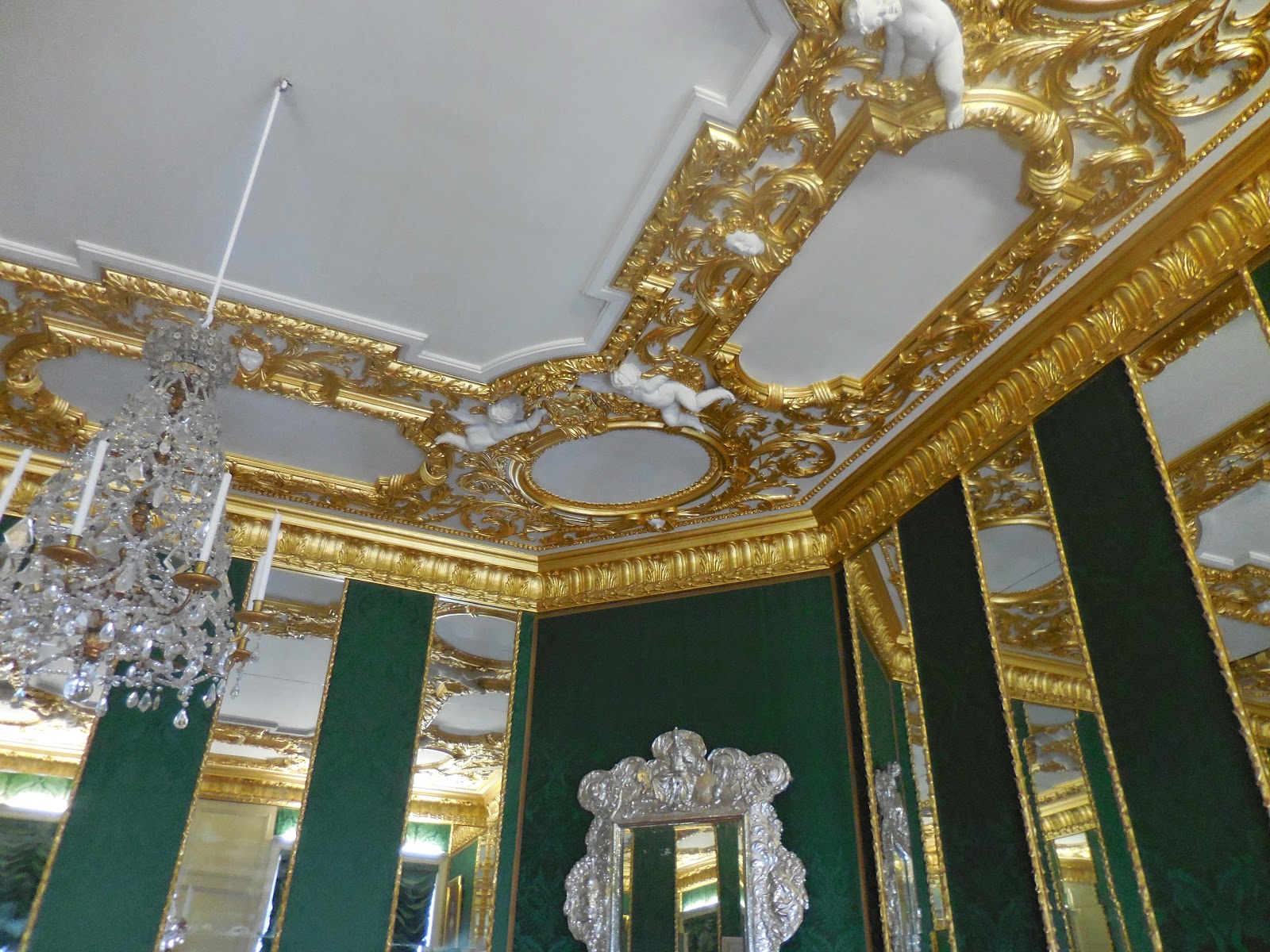
Charlottenburg is a beautiful example of the early days of the Enlightenment come to life.  Built under the direction of Queen Sophie-Charlotte as a summer home in the late 1690's, it stood outside the city gates of Berlin at the time.  Throughout the tour of this beautiful palace, our audio guide reminded us of the love of Sopie-Charlotte and her husband, King Frederick I of Prussia (they were the first to call themselves "king" and "queen" of Prussia; before that, they had been called "Elector" and "Electress") for all things cultural.  In fact, portraits throughout the palace contain the likenesses of various philsophers, scientists, and artists.  

Sophie-Charlotte also had a passion for the chinoiserie style that swept through Europe at the time.  One room, in fact, had a massive--and I mean massive--display of Eastern porcelains and such.  It all must have been the latest in chic, exotic culture at the time.

While the first floor was dedicated to Sophie-Charlotte and Frederick, the second floor focused on the mid-19th century life of their desendant Frederick-William IV and his Queen Elizabeth.  Here, where much of the original structure had been damaged in WWII, a lot of the rooms are more like museum displays.  The discussion of the revolutions of 1848 and Frederick-William's response to them served to underscore just what a difficult time European monarchies had as a passion for democracy swept across the Western world.  While it would take many more decades to complete, those stirrings in 1848 proved to be the beginning of a new way of political thinking in Europe.

The following are the few photos that Heidi surreptitiously took during the tour.  Surreptitiously taken, because permission to take photos in the palace cost an additional three Euro.  While I can see restricting things like flash photography, the idea of charging visitors to take personal snapshots seems a bit of a money grab.  However, imaging how much it must cost to keep up the beautiful palace and grounds, I'm guessing every Euro counts.


OK., so this photo was taken by me, and
I am not as sly as Heidi. But what a great
bust of an angry baby!

Once we had seen the sights of Schloss Charlottenburg, we hopped back in the car for a ride to Onkel Werner and Tante Cissy's apartment.  All along the way, Onkel Werner kept up a steady stream of tour guide information, pointing out this and that, all in his multi-cultural patois.

Tante Cissy, to me, looked the same as she has ever looked, as though she has not aged at all in the decades since I saw her last.  She had a very elegant tea set up for us, complete with the most amazing cocont-pineapple cake, fresh whipped cream, coffee, tea, and chocolate milk.  Onkel Werner and Reiner looked over Werner's stamp collection, while I photographed pages of family history information that Werner had put into a little book. 


Once tea was finished, then out came the alcohol. Whiskey, of course, for Maddie, beer for the rest of us.  It wasn't long before their son, Manfred, arrived, along with his girlfriend, Kristine.  Piled into two cars, we drove a short way to their favorite restaurant for dinner--Manfred knew everybody there!


From left to right: Manfred, Reiner, Maddie, Heidi,
me, Werner, Cissy, Katarina (the youngest
daughter of Kristine), and Kristine 

After dinner, Reiner saw his most cherished wish fulfilled--we went to Klo, the toilette-and-horror themed bar in the northern part of Berlin.  This racuous place shoots you with water when you enter, where you are greeted by a mannequin that flashes you with quite a substantial piece of "wood."  Some bar stools come in the shape of toilets, the actual toilets make farting noises, and drinks are served in things like test tubes, bedpans, and urinals.  A good time was, of course, had by all.


It was late by the time we got home, so this blog simply had to wait.  Now, it's morning and Melli has arrived.  Reiner is on his way to get breakfast foods, and then its off to the German History Museum.  I must finish this up and publish as my most devoted reader, Melli, sits near me, waiting impatiently.


Saturday, April 25, 2015

The Dark Side of the Past

We woke up in Mischa and Tina's adorable little house to find a traditional German breakfast waiting for us--brötchen, cheese, meats, Nutella, jams of various kinds, yogurt, fresh cantaloupe, pineapple, and strawberries, milk, orange juice, coffee, and, of course, Coke Cola!!  All eating was carefully witnessed by Kira, the Norwegian Ridgeback, who was given Heidi's leftovers and seemed very happy about it.

I can't say enough how nice the house is that Mischa built in Flatow.  I wish my bathroom was as big!  Tile floor, a glass shower, and the most inviting deep bathtub I've seen in quite a while.  If only I hadn't slept late maybe I could have had a quick dip.

After breakfast, we piled into Florian's van, which seats seven but did not include Florian, who had to work.  Mischa, Tina, and the four Herbon travelers drove through the beautiful little town of Kremmem next to Flatow, where we could marvel at the old houses and cobblestone streets.  Soon we arrived in Oranienburg, where the Sachsenhausen concentration camp lies on the outskirts of town.


The original concentration camp in this area was located in the middle of Oranienburg, on the grounds of an old brewery.  This camp mainly held the political enemies of the newly triumphant Nazi party, who had swept to power in the elections of 1933. This camp was abandoned, and a new camp was built, by prisoner labor, that became Sachsenhausen in 1936.

According to the brochure, more than 200,000 people were imprisoned at the camp between its building in 1936 and its liberation by Soviet and Polish troops in April of 1945.  By the time of its liberation, the Nazis had either exterminated or death-marched the prisoners away from the camp to keep them from being freed, leaving only 3,000 who were too sick to move to be found by their liberators.  One particularly moving account of the liberation was given by a Polish prisoner in the camp, who threw himself into the arms of the Polish soldier who found him and who happened to be from the same Polish town.

While the camp was not a death camp, like Auschwitz and Dachau, the SS still managed to exterminate quite a few of the camp's inhabitants.  Those who were not starved or who did not die of disease could find themselves as unwilling participants in medical experiments, gassed in the camp's small gas chamber (blown up by the East Germans in the early 1950s--but I don't know why), or taken to the "death trench" to be summarily shot and killed. Of course, the ovens worked all day long, burning the corpses. They couldn't run at night as the flames shooting out from the chimney might have attracted Allied bombers--how surreal is that?

From inside the camp kitchen--happy potatoes washing up

As much as the camp tells the story of what occurred there, the curators also include a lot of information about how the present memorial site was conceived and how it came to be.  Decisions about what to keep, what to get rid of, how to display artifacts, and what stories to tell are all explained.  Like the Jewish museum in Berlin, an emphasis is really placed on telling personal stories.
......

O.K., here I must stop for a minute to explain that, on the couch next to me, Mika and his Schatzie, are having quite a bit of fun with play power tools.
......

Anyway, several things about the camp memorial really stood out.  As you approach the entrance to the actual camp, there is a wooded area in which various family and/or groups have placed memorials to persons or people who perished in the camp.  Unfortunately, a sound system has been installed, making it seem as though other-worldly souls were speaking from under their memorials.  


Somehow, this cross that fell out of its
granite is very moving 

Many nations and groups have left floral wreaths with big ribbons to mark various sites within the camp.  The largest collection of these wreaths lies in front of Station Z--the last stop for many prisoners and the location of the "death trench," gas chamber, and ovens.  It seems as though most nations in Europe were represented, many more than once, but I only found one from the U.S.A.

Strange thing about visiting Station Z:  while seated on a "bench," our little party, along with other tourists, was scolded by an English-speaking tour guide. Apparently, the "bench" was actually a marker over the cremains of some of those killed in the camp.  Hey, lady, if you don't want people sitting on the ashes, don't make their marker in the former of a bench (I didn't say this, but some other man said something to this effect, and scolded the tour guide right back).


The Jews imprisoned at Sachsenhausen appeared to have been kept separate from the other prisoners. One of their special barracks remains, with an exhibit about the Jewish experience at the camp.  As moving as it is, efforts to honor the others murdered at the camp are just as compelling.  There is a section devoted to the homosexuals interred and killed, as well as several examples of Jehovah's Witnesses who found themselves enemies of the Nazi state.


There is so much  more to learn about the camp, right?  It is important to know as much as possible, right?  I must be able to teach my daughters about it, right?  Yes, and that's how I justified buying a book, when I have an iron-clad book-purchasing embargo on this trip.


The death trench


Mischa, Tina, and Reiner 

Selfie for Heidi and her mom

After the camp, we were all tired, hungry, and thirsty.  Mischa and Tina had kindly stocked the van with water and juice, but harder liquids were called for.  They took us to a "Mexican" restaurant, which turned out to be more of a German version of Spanish-Mexican-South American-Cuban food.  Nachos are chips with cheese melted on top, with a side plate that contains little pots of salsa, sour cream, and guacamole.  My carne tacos came with onions and bell peppers, huge chunks of beef, and melted cheese stuffed into crispy shells that broke upon contact.  As I try to roll along with new things, I ate my tacos with a fork, a first for me.  They also came with fries, which reminds me of having lunch with Princess Brenda at Del Taco.

Nachos?

Now we are back at Petra's.  The girls went to a nearby shop, and we now have a gift to bring home to a certain nephew of mine. They then went out again, this time with Reiner and Sascha, to buy presents for the two little boys of Berlin who have completely enchanted us. Tomorrow the plan is to visit the Reichstag and then to spend the afternoon and evening with Onkle Werner and Tante Cissy.

Two things that I forgot to mention from yesterday:  the trip with Mischa on the autobahn saw speeds of 110 m.p.h. (pretty damned exciting); and Mischa took us past the house in the Charlottenburg area of Berlin in which Reiner lived with his brother and parents before they came to the U.S.  Cool!

I'm closing now to read my new book while Petra talks on the phone and Mika watches Chuggington on television. Just a night in beautiful Berlin...